


The Hearty Blog
CoQ10
CoQ10 - What is it and why is it important?
Coenzyme Q10 or CoQ10 is a vital vitamin-like nutrient that helps the body produce the energy that allows it to function. Our cells need CoQ10 for proper growth and maintenance. It is the vehicle that transports the electrons across the crucial energy production processes within our bodies. CoQ10 is regarded as an essential nutrient for cell regeneration and supports a long, healthy and productive life.
Researchers have spent years (since its discovery in the 1950’s) studying CoQ10, its essential functions in the body, how and why it declines and how best to replenish it. This research is one of the main reasons why cardiologists now recommend CoQ10 supplements to their patients more frequently than any other supplement, including Fish Oil.1
CoQ10 is Present Everywhere
CoQ10 is endogenous to the human body – meaning that we produce it naturally and we all have it. From our vital organs, to every muscle in our bodies, we find CoQ10 in practically every cell. In fact, the names ubiquinone and ubiquinol (the two most common forms of CoQ10 found in our bodies) both derive from the Latin “ubiquitas” (modern day English: ubiquitous), which literally means “present everywhere”.
CoQ10 is Responsible for Energy Production
CoQ10 is a naturally occurring nutrient-like coenzyme that plays an important role in the production of 95% of the energy used by our cells and organs. This energy is generated by a complex series of chemical reactions that culminates in the production of Adenosine Triphosphate or ATP, which is the way in which our bodies store energy.
CoQ10 is an Important Antioxidant
CoQ10 also acts as an antioxidant and helps protect our cells from damaging molecules known as free radicals that may lead to cell damage. Free radicals are reactive molecules that are formed by normal body functions (breathing, general physical activity and stress) and which can cause damage to healthy cells. They are also formed in response to external factors such as smoking and exposure to UV rays from the sun. They can attack the DNA of the cell, which may cause cellular damage.
CoQ10 is a fat-soluble antioxidant your body produces on its own, neutralizes free radicals and can help protect your cells from damage.
Find Our What Makes us The Gold Standard in CoQ10
SHOP NOW
References
1IQVIA ProVoice Survey
CoQ10
Statin Users, CoQ10 is Your New Best Friend
Following your doctor prescribed cholesterol lowering regimen that may include eating healthy, exercising regularly, and taking cholesterol medication such as statins can help keep your cholesterol in check.
However, it’s a bit of a double-edged sword. While statins help to keep your cholesterol levels under control, they can also deplete your body of essential compounds and chemicals that keep the body running smoothly.
More importantly, if you have high cholesterol and are currently taking statin medication, you run the risk of significantly lowering your normal CoQ10 levels, something that could compromise your normal body functions.
What is CoQ10?
The term may look like something off the molecular chart from your high school science class, but coenzyme Q10 is the only name we have to describe this essential antioxidant.
What does it actually do, though?
You could say that CoQ10 is a bright spark in the tinder box, as it gets everything fired up. From vital organs to muscles, you’ll find CoQ10 in every cell (did you know that the highest concentrations can be found in your heart, liver and kidneys?), balancing electrons, producing energy and fighting off free radicals. It’s the life of the party! In essence, it’s an energy-producing coenzyme that keeps your engine running on all cylinders.
The Power Plant of Every Living Cell
It’s hard to imagine our cells busy at work, rushing through our bloodstream to every organ and muscle in the body, repairing, building, and fighting off intruders. It’s a beehive of industry and this requires a lot of energy. This energy is produced by a complex series of biochemical reactions that results in the production of Adenosine triphosphate (ATP), which is the energy currency of the cell. CoQ10 is essential to this process due to its electron transfer characteristics and is in fact a vital factor for 95% of the overall energy production at the cellular level.
Thanks to CoQ10, this energy breathes life into your body and keeps it functioning optimally. However, when you’re taking statins, CoQ10 levels are significantly lowered.
What Happens When There’s a Shortage of CoQ10?
As you get older, CoQ10 levels naturally decline and researchers have identified CoQ10 deficiency as a contributing factor to many health conditions. CoQ10 is often recommended by general practitioners and cardiologists alike as a dietary supplement to help assure adequate levels of this coenzyme, especially if you’ve been prescribed statins. It has also proven to be an effective after-care supplement for heart failure, heart surgery, and chemotherapy.
CoQ10 is found in a bunch of foods like meat, fish, and whole grains. In a healthy, balanced diet, it should be in adequate supply.
Your organs require huge amounts of CoQ10 to carry out their daily functions. So you can understand how vital this antioxidant is to ensure their health.
Is CoQ10 Good for Muscle Pain Caused by Statins?
CoQ10 is in hot demand by the body, as its role is critical in maintaining the overall health of your body. Your organs rely on it, and so too do your muscles. In fact, they can't function without it.
During any given day, your muscle fibers break down and rebuild in order to get stronger. It’s a bit like housekeeping. Old muscle cells are swept away, with the arrival of fresh cells that are brimming with life.
Deep inside these muscle fibers, you’ll find CoQ10 delivering fresh energy stores to cells in need, as well as warding off intruders. But when levels of CoQ10 are compromised by statins, proper muscle function can be impaired, and the whole process begins to collapse. The result is muscle pain and joint stiffness – one of the common side effects of statins. Muscle soreness can seriously affect your mobility, not to mention, your quality of life. It also increases your risk of falling, as it leaves you unsteady on your feet.
According to a study published in the American Journal of Cardiology, CoQ10 can help alleviate muscle pain and joint discomfort brought on by statin drugs:
“Results suggest that coenzyme Q10 supplementation may decrease muscle pain associated with statin treatment. Thus, coenzyme Q10 supplementation may offer an alternative to stopping treatment with these vital drugs” – American Journal of Cardiology
Not only is CoQ10 essential in maintaining heart and organ health, it is also instrumental in the proper functioning of your muscles. And one of the secrets to longevity and quality of life is strong muscles.
CoQ10 And Statins – It Makes Sense to Supplement with CoQ10
This vital coenzyme is so essential to the body that you’ll notice immediately if you’re in short supply. Because statins can rob your body of this vital component, it makes sense to supplement your diet with CoQ10. There’s also the added health benefit of its anti-aging, antioxidant properties that help to prevent free radicals from damaging your tissues.
Talk to your doctor to see if CoQ10 is right for you, especially if you’re currently taking statins. It’ll make all the difference to your quality of life.
Shop for Qunol CoQ10 supplements or contact us with any questions about statins and CoQ10.
COQ10 SOURCES & REFERENCES
Coenzyme Q10 (CoQ10) : In Depth; National Center for Complementary and Integrative Health
https://nccih.nih.gov/health/supplements/coq10
CoQ10 and Statins: What You Need To Know : Healthline
http://www.healthline.com/health/coq10-and-statins#Overview1
CoEnzyme Q10, An Overview : Web MD
http://www.webmd.com/heart-disease/heart-failure/tc/coenzyme-q10-topic-overview
Effect of coenzyme q10 on myopathic symptoms in patients treated with statins:
American Journal of Cardiology
Ghirlanda G., Oradei A., Manto A., et al. Evidence of plasma CoQ10-lowering effect by HMG-CoA reductase inhibitors: a double-blind, placebo-controlled study. J Clin Pharmacol. 1993;33(3):226–229.
Blood Pressure
Ubiquinol vs CoQ10 - What's the Difference?
CoQ10 Exists in Your Body Primarily in Two Forms:
If you’ve been researching CoQ10, you have likely noticed that there are two forms of CoQ10 supplements available: ubiquinone and ubiquinol.
Ubiquinone (the oxidized form of CoQ10)
Ubiquinol (the reduced form of CoQ10)
Your body utilizes both forms of CoQ10 and is constantly converting between ubiquinone and ubiquinol depending on its current need.
Studies show that when we are young, our bodies synthesize ubiquinone well, converting it readily to ubiquinol. But as we get older, the body's ability to convert ubiquinone to ubiquinol can diminish. Ubiquinol supplements contain a form of CoQ10 that has already been converted to its antioxidant form, ubiquinol – the form that fights excess free radicals and can help protect the body's cells from damage.
Oxidation is a normal process both in nature and in the human body. We see it at work in nature when a sliced apple turns brown or when iron rusts. In the human body, excess oxidation can damage healthy cells. Our bodies are designed for this process and are constantly producing new cells to replace the old. However, as we age and are exposed to certain environmental factors, the oxidation process can overwhelm the body’s ability to cope with it. Oxidation can lead to the formation of excess free radicals, unstable molecules that can cause cell damage. Ubiquinol is a powerful antioxidant that helps fight against free radicals.
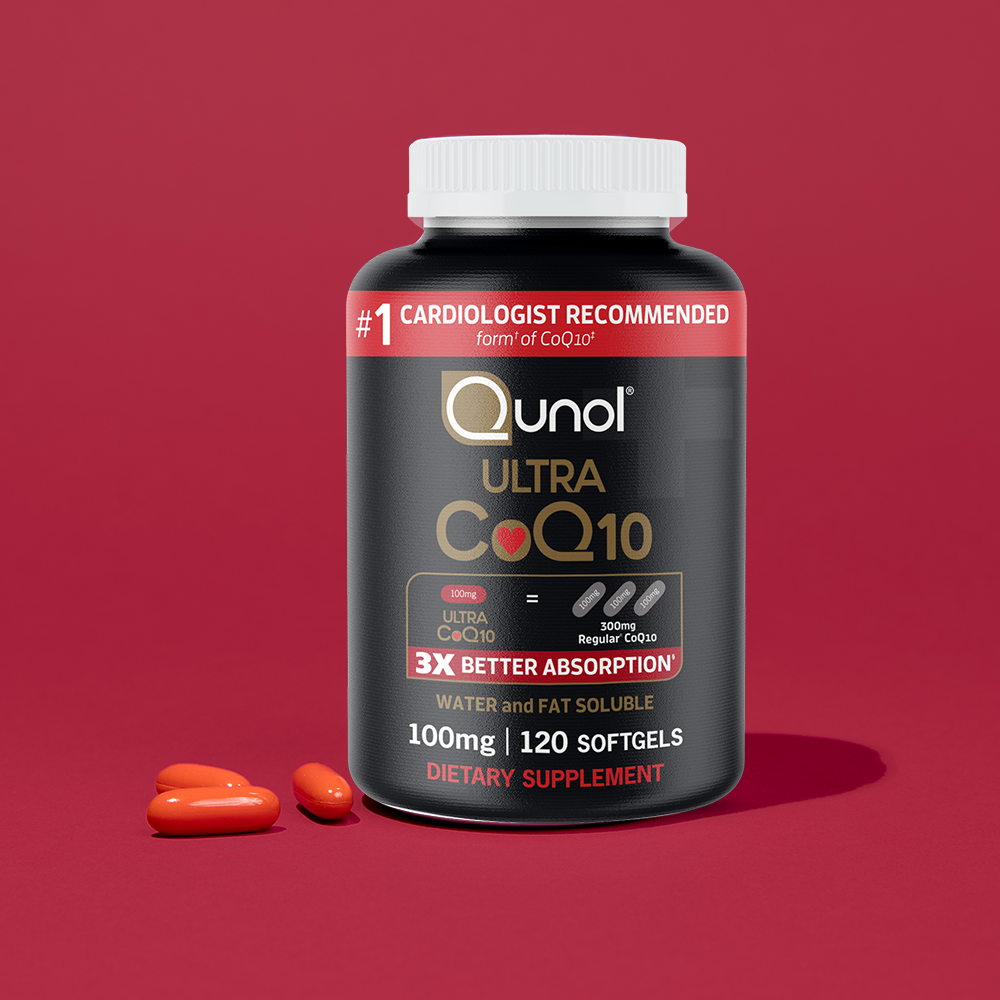
It's important to note that our Qunol Ultra and Mega are both water and fat-soluble and are better absorbed than a regular¹ form of CoQ10.
These statements have not been evaluated by the Food and Drug Administration. This product is not intended to diagnose, treat, cure, or prevent any disease.
1 Regular CoQ10 refers to unsolubilized ubiquinone in oil suspensions in soft gels and/or powder filled capsules/tablets
Blood Pressure
What Makes Your CoQ10 Levels Decline?
CoQ10 Levels Decline Naturally With Age
CoQ10 is endogenous to the human body – meaning that you produce it naturally and we all have it. However, our body’s natural ability to produce CoQ10 decreases as we age.
Unfortunately, the amount of CoQ10 we typically get from our regular dietary intake may not be enough to compensate for even our normal age-related decline in CoQ10 levels.
Cholesterol Lowering Medications – Statins – May Reduce Your CoQ10 Levels
Statins, or by their proper name “HMG-CoA reductase inhibitors”, are the type of cholesterol management medications most often prescribed in the United States.
Your body produces cholesterol in a pathway in your liver. It is within this same pathway that your body produces other essential compounds and chemicals including CoQ10. Because statins work by blocking the production of cholesterol in this pathway, they may also block the production of CoQ10.
This could potentially complicate other health issues and leave you vulnerable to side effects from your prescribed statins. Talk to your healthcare professional to learn more.
*These statements have not been evaluated by the Food and Drug Administration. This product is not intended to diagnose, treat, cure, or prevent any disease.
Blood Pressure
Benefits of CoQ10
Supports heart and vascular health
Promotes healthy blood pressure levels1
Essential for energy production
Beneficial to statin drug users2
Powerful antioxidant
CoQ0 is a naturally occurring nutrient-like coenzyme. The primary function of CoQ10 is to help with cellular energy production. It is the powerhouse of every cell in our bodies and exists at the most basic level of each cell’s operation- the mitochondria. It is in fact present in the cells of all living organisms, from bacteria to plants, all animals, and humans. CoQ10 is also an antioxidant and helps protect our cells from damaging molecules known as free radicals that may lead to cell damage.
The main benefit of taking a CoQ10 supplement is to assist you in restoring your CoQ10 levels that might have been depleted due to our natural aging process or due to a variety of external factors such as stress, and the use of cholesterol lowering statin drugs.*
Helps Support a Healthy Heart
No other organ in our body requires more energy and works harder than our heart. During an average lifetime, your heart will beat more than 2.5 billion times (that is more than 100,000 times a day!). It takes a lot of energy for your heart to operate at peak level. Since CoQ10 is so vital to the production of energy at the cellular level, it should come as no surprise that your heart has the highest concentration of CoQ10 found anywhere in the body. CoQ10 can help support heart and vascular health, and helps maintain healthy blood pressure already within a normal range.*
References
*These statements have not been evaluated by the Food and Drug Administration. This product is not intended to diagnose, treat, cure, or prevent any disease.
1Helps maintain healthy blood pressure already within a normal range.
2 Cholesterol-lowering statin drugs can deplete the body's natural levels of CoQ10. Qunol can help replenish lost CoQ10 due to statin drug therapy.
CoQ10
How Can You Boost Your CoQ10 Levels?
We Get Minimal Amounts of CoQ10 From Our Diets
Animal-based products and, in particular, organ meats such as heart and liver are relatively good sources of CoQ10. Lower amounts of CoQ10 are also found in beef, pork, chicken, and fatty fish such as tuna. In reality, though, it is not likely that a person could consume large quantities of any organ meat needed to have a reasonable amount of CoQ10 from their diet.
The Best Way to Boost Your CoQ10 Levels Is Supplements
Since the typical diet does not provide enough CoQ10 to reach recommended levels, taking a CoQ10 supplement is a good way to help increase CoQ10 levels.
Talk to your doctor to discuss a dose that might be appropriate based on your health status and medications you are taking.
Children under 18 should not be given CoQ10 (or any other supplement) unless under the supervision of a health care provider.
*These statements have not been evaluated by the Food and Drug Administration. This product is not intended to diagnose, treat, cure, or prevent any disease.
Blood Pressure
Why is CoQ10 the Most Recommended Supplement By Cardiologists?*
CoQ10 is Important for Heart HealthCoQ10 is a naturally occurring nutrient-like coenzyme that plays an important role in the production of 95% of the energy used by your body at the cellular level. CoQ10 is also a powerful antioxidant that can help protect your cells from damage. Unfortunately, your CoQ10 levels can drop due to age, stress, and cholesterol-lowering statin drug therapy.1 While small amounts of CoQ10 can be found in food, taking a daily CoQ10 supplement is the easiest way to increase your CoQ10 levels.CoQ10 and Cholesterol-Lowering Statin DrugsBoth cholesterol and CoQ10 are produced in the same pathway. Statins work by blocking this pathway, but they also block the production of CoQ10. Statin medications have been shown to lower CoQ10 levels by as much as 40% and the addition of a CoQ10 supplement to statin drug therapy can help replenish low CoQ10 levels.2
Click here to download our free Statin Side Effects e-Book! [link to statin side effects eBook landing page]
CoQ10 for Heart and Vascular HealthCoQ10 supports your cardiovascular system in two ways:
-It plays a role in producing the energy needed by your heart-It helps protect your heart muscle from damaging molecules such as free radicalsAccording to results from a multinational clinical study, long-term supplementation with CoQ10 is safe and effective for promoting healthy heart function.3CoQ10 can also help support blood pressure levels that are within normal ranges.
Water and Fat-Soluble Qunol® CoQ10 is the Better Choice for Heart Health
Qunol® CoQ10’s patented formulation is water and fat-soluble, unlike regular4 CoQ10 that does not dissolve in water and dissolves poorly in fat. Studies show that Qunol® Ultra is up to 3X better absorbed than regular4CoQ10 so it can help you reach optimal levels of CoQ10 in just weeks – rather than months, so you can experience the potential benefits faster.5
References
*AlphalmpactRx ProVoice Survey.
1Fuke, C., Krikorian, S.A., Couris, R.R.. (2000). Coenzyme Q10: a review of essential functions and clinical trials. US Pharmacist, 25(10), 28-41.2Ghirlanda G., Oradei A., Manto A., et al. Evidence of plasma CoQ10-lowering effect by HMG-CoA reductase inhibitors: a double-blind, placebo-controlled study. J Clin Pharmacol. 1993;33(3):226–229.3Mortensen SA, Rosenfeld F, Kumar A. The effect of coenzyme Q10 on morbidity and mortality in chronic heart failure: results from Q-SYMBIO: a randomized double-blind trial.4Regular CoQ10 refers to unsolubilized ubiquinone in oil suspensions in soft gels and/or powder filled capsules/tablets
5Chopra, R.K., et al. (1998). Bioavailability of Coenzyme Q1O in Humans. Internal. J. Vit. Nutr, Res. 68, 109-113. Received for publication August 4, 1997.
CoQ10
Why Qunol's CoQ10 is Better
Many of us are currently taking a CoQ10 supplement to help restore our CoQ10 levels. Our levels can be depleted due to age, stress, and cholesterol-lowering medications (statins) and CoQ10 supplements are a good way to restore CoQ10. CoQ10 is also important because it is essential for energy production, supports heart and vascular health, and is a powerful antioxidant.
If you are not truly absorbing your CoQ10 supplement, you may not be able to experience its potential benefits. Regular1 CoQ10, typically found in most powder-filled capsules and softgels, struggles with absorption because of its large molecule size and the fact that it often dissolves very poorly in fat and does not dissolve in water (such as the water-friendly environment found in our intestines).
Choose a Soluble CoQ10 Supplement for Superior Absorption
Our intestines are a water-friendly environment and water-soluble substances absorb more efficiently than fat-soluble substances. This is why water-soluble forms of CoQ10 supplements absorb better than regular1 CoQ10. Choosing a CoQ10 supplement that is water-soluble, in addition to fat-soluble, ensures that your body will absorb more of the CoQ10 and allow you to experience its potential benefits.
In order for CoQ10 to be effective, serum levels must reach high enough concentrations in the bloodstream. Some research has shown that water-soluble CoQ10 leads to significantly higher serum levels than regular CoQ10.2
Because of the absorption issues with regular CoQ10, a common practice is to take very large doses in the hopes that more will be absorbed. However, this brute force approach can get expensive in a hurry, and still only offers minimal incremental benefits.
A better option is to choose a CoQ10 supplement that is both water and fat-soluble to ensure you reach therapeutic levels quickly and efficiently.
Qunol® CoQ10 Supplements are the Better Choice
Qunol® CoQ10 uses a unique formulation that is water and fat soluble, unlike regular1 CoQ10 that does not dissolve in water and often dissolves very poorly in fat.
Studies show that Qunol® Ultra is up to 3 times better absorbed than regular CoQ10,2 and that it can help you increase levels of CoQ10 in just weeks – rather than months like regular CoQ10, so you can experience the potential benefits faster. This is why Qunol® has the #1 cardiologist recommended form of CoQ10.³
References
1Regular CoQ10 refers to unsolubilized ubiquinone in oil suspensions in soft gels and/or powder filled capsules/tablets
2Chopra, R.K., et al. (1998). Bioavailability of Coenzyme Q1O in Humans. Internal. J. Vit. Nutr, Res. 68, 109-113. Received for publication August 4, 1997.
3 IQVIA ProVoice Survey. (Form refers to water and fat-soluble CoQ10).

Heart Health
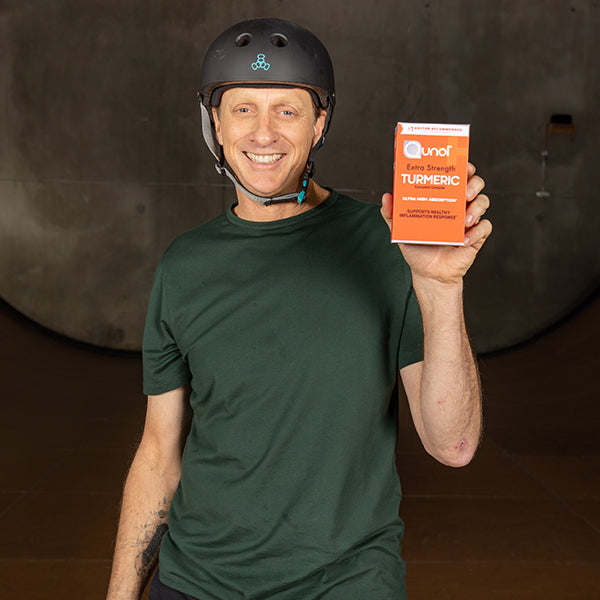
Qunol Is Back with Tony Hawk and He’s Still Keeping Up With Life’s Turns Thanks to CoQ10
Discover how Qunol CoQ10 helps support his heart and active lifestyle—including grandparent mode.